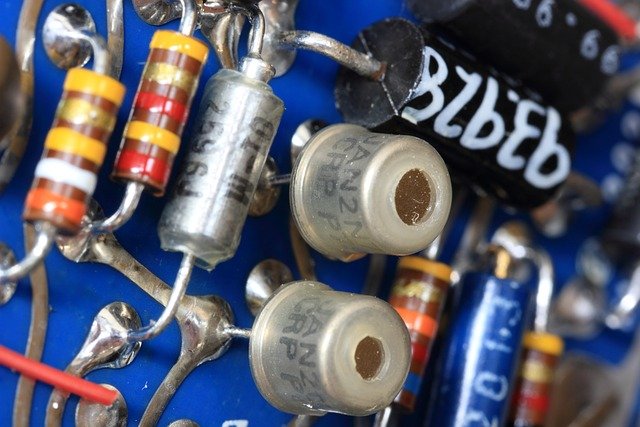
Capacitors are fundamental components in electronic circuits, playing a crucial role in a wide range of applications, from power supply filtering to signal coupling. Despite their small size, capacitors have a significant impact on the functionality and performance of electronic devices. In this article, we’ll delve into the world of capacitors, exploring their role in electronics and why they’re essential components in virtually every electronic circuit.
What is capacitor?
At its core, a capacitor is a passive electronic component that stores and releases electrical energy. It consists of two conductive plates separated by an insulating material called a dielectric. When a voltage is applied across the plates, an electric field forms in the dielectric, causing the capacitor to store energy in the form of an electrostatic field.
What is the role of capacitor in circuit?
Energy Storage: One of the primary functions of capacitors is to store electrical energy temporarily. They can quickly charge and discharge, making them ideal for applications requiring rapid energy delivery, such as flash photography or power supply smoothing.
Filtering and Decoupling: Capacitors are commonly used for filtering and decoupling purposes in electronic circuits. They help remove unwanted noise or ripple from power supplies, ensuring a stable and clean voltage for sensitive components.
Signal Coupling: Capacitors are often used for coupling signals between different stages of a circuit. They allow AC (alternating current) signals to pass while blocking DC (direct current) signals, enabling the transmission of AC signals without affecting DC bias levels.
Timing and Oscillation: Capacitors, along with resistors, are essential components in timing circuits and oscillators. They determine the frequency of oscillation and the timing characteristics of various electronic circuits, such as clocks and timers.
Motor Start and Run: In electric motors, capacitors are used for starting and running operations. Start capacitors provide the initial boost to start the motor, while run capacitors help maintain a steady voltage and improve motor efficiency during operation.
Types of Capacitors
Capacitors come in various types, each with its unique characteristics and applications. Some common types include:
Ceramic Capacitors: Small, inexpensive, and widely used for high-frequency applications.
Electrolytic Capacitors: Larger in size, with high capacitance values, suitable for filtering and energy storage applications.
Film Capacitors: Offer high stability and reliability, suitable for timing circuits and audio applications.
Tantalum Capacitors: Compact and reliable, with low ESR (Equivalent Series Resistance), ideal for portable electronics and power supply filtering.
Capacitors are indispensable components in electronic circuits, serving a multitude of functions ranging from energy storage to signal coupling. Whether you’re building a simple LED flasher or a complex audio amplifier, chances are you’ll need capacitors to ensure proper operation and performance. By understanding the role of capacitors in electronics and selecting the right type for your application, you can unlock the full potential of your electronic projects and creations. Capacitors have labels on them for their values. Here you can find more about how to read capacitor labels.